


PROUDLY
CANADIAN
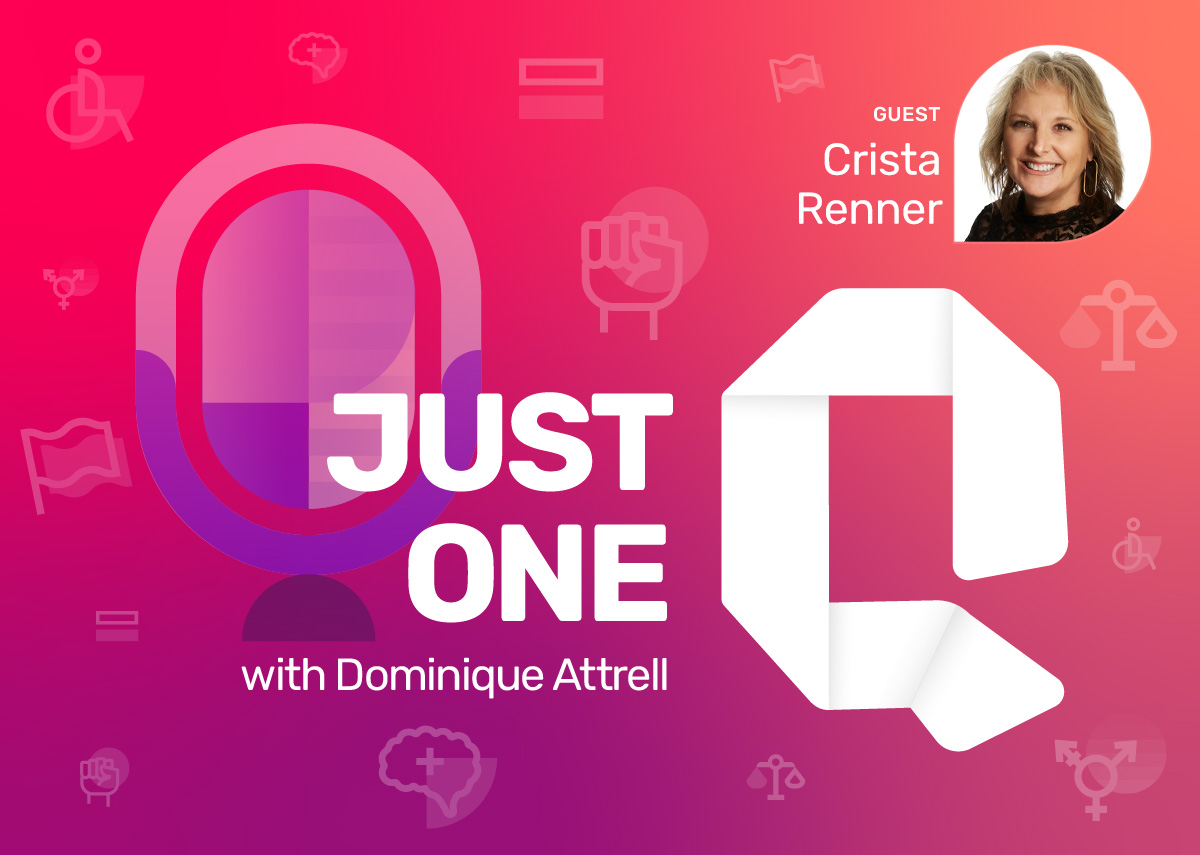
On this episode of Just One Q, Dominique chats with guest Crista Renner, a mediator specializing in workplace conflict and culture dynamics. They discuss the role of culture, systems, power dynamics, and peoples’ upbringings and trauma responses in shaping workplace conflict and suggest tools to help us approach conflict with more intention.
Dominique: Welcome to Just One Q the podcast where we explore the latest ideas in workplace diversity, equity, and inclusion in conversation with thought leaders and experts. Each episode, a guest and I dive into a question that highlights their area of expertise. The goal is to leave you with the tools and insights that you can use to make your workplace better and more human friendly.
I’m your host, Dominique Attrell. I’m a DEI educator and advocate working for Dialectic, an inclusive workplace learning consultancy in lovely Guelph, Ontario, which is situated on the treaty lands and territories of the Mississaugas of the Credit First Nation and the traditional lands of the Chonnonton and Haudenosaunee Peoples.
I am really looking forward to today’s conversation with Crista Renner. For nearly 20 years, Crista has worked with organizations to build stronger and more resilient teams, helping them to develop conflict competent workforces that can improve collaboration, increase trust and transparency, foster inclusivity, Reduce unhealthy tension, problem solve more effectively and enhance employee wellbeing.
That’s quite a list. Crista is fascinated by the transformative role of conflict in driving innovation and deeply understands that tension can either be a catalyst for breakthroughs or a barrier to success. Her in depth knowledge of emerging trends and best practices allows her to design and implement.
Innovative solutions that position organizations for long term success. Her expertise extends from her experience in the C suite as the co founder of Juice Inc, to her work with startups at Velocity and the Problem Lab at the University of Waterloo, and with some of Canada’s most progressive leaders at Ivy Business School’s Innovation North.
Crista holds a master’s in peace and conflict studies from Conrad Grebel College at the University of Waterloo, a BA in justice studies and a diploma in corporate communications. She’s also a qualified mediator with an intercultural designation and a restorative and workplace fairness practitioner.
Welcome to the show, Crista.
Crista: Take a breath.
Dominique: I know, right? It’s all you
Crista: words in there. Yeah. Thank you. Thank you so much Dominique.
Dominique: Well, it’s my pleasure to have you here. And I’m very excited because the key question we’re going to explore today is how can we lead healthier conflicts at work? And I’m Very glad that we’re talking about this and in particular right now because of the current socio political climate, uh, seems that deep divisions are spilling over into our conversations in pretty much every sphere of life, including the workplace.
And not just that, but I also feel like maybe it’s just me, but I have this feeling that people aren’t as skilled at conflict as they used to be. We all know what the comment section of just about any social media post looks like, so. The first thing I want to do is maybe reframe conflict just a little bit.
So, you know, even in your bio, I mentioned that you view conflict as potentially a very positive thing going so far as to say that it can enhance wellbeing. So I want to get your perspective on. what healthy conflict is and what the benefits of it could be in the workplace?
Crista: Well, thank you very much for having me.
And it’s not that I get excited when I see conflict, because that’s not the case. It’s that conflict is all around us, regardless. And If it’s not on the table, it’s below the surface, and I’ll call that latent conflict. And so, not to get into the weeds too much, but from a socio political environment, there has been a lot of latent frustration below the surface, and now it’s above the surface.
And so, if, You are, um, dealing with conflict when it’s below the surface. It can be passive aggression. It can be what I call boxing the shadows that something’s not right here. I don’t know what it is. And I mean, um, one of the terms that’s being used on TikTok right now is artificial harmony. In context of conflict between parent and child, that yes, everything’s okay.
Everything’s great. But that artificial harmony pushes whatever isn’t great down below the surface. And so
the conflicts exist. The question is, are we going to make it healthy conflict and navigate it in a healthy way? Or are we going to do it in the way we learn from our families of origin, mostly, where most people haven’t been taught the skills of conflict competency and how to navigate conflict healthily.
And it’s not just the active listening and the curiosity and the questions and the emotional intelligence that all come together. It’s really looking at from a deep personal perspective, how do you respond to conflict in your body, for example? Do you feel it here? Do you feel it in your breathing? Do you feel it in a migraine?
And this is where being aware of your own personal contribution to conflict in your life and how you responded to it as a child can affect how you’re responding to it in the workplace. So now I want to come back to your question and get you to ask me the question again, because I feel like I,
Dominique: yeah, no, I absolutely not.
It’s really the idea of what’s the benefit, the potential benefit of healthy conflict. So I think you’ve kind of painted a picture where there’s latent conflict or hidden or, sort of under the surface conflict. And if we do ignore it, There are pitfalls there. Um, but we can address it health, healthfully if we know how to healthily.
Um, so what are, what are the benefits of that healthy conflict in a workplace potentially?
Crista: Yeah. Let me turn your question around a little bit. Sure. And go back to this concept of artificial harmony. What happens if there’s a lack of conflict in the workplace? What’s happening? If everything appears to be going well And that would be stifled innovation because innovation relies on diverse points of view. It relies on understanding where different people are coming from, an example of this that, I was made aware of like years ago when Apple came out with their health app.
They didn’t have any menstrual tracking on that app. And it was discovered that there were no women on the team creating this health app.
Oops.
Crista: Right. And so that’s a very simple. Perspective on just lack of gender diversity. And even if we’re talking about gender, we’re talking about a spectrum.
And so anytime you have a binary, it can create conflict if it’s your idea against my idea. And so a lack of conflict. Can prevent effective innovation and effective ideas coming and instead of just bringing two perspectives or three perspectives or four perspectives, you’re now looking at the bigger picture.
Um,
Crista: another, uh, example of a lack of conflict or why it’s important to navigate conflict well is it creates power dynamics. Just about every time you have a conflict, there is an issue of power or privilege within the dynamic. And so if there’s no conflict on our team at all, it’s probably because I may have a certain sense of power in the relationship.
And so what I say goes. Not all the time. And again, it’s not, it’s not about the person necessarily, but it’s the system that’s been created. The power that I’ve been given by the system because of policy, because of longtime practice, because of beliefs, because of values. So, again, Healthy conflict ensures that some of these power dynamics are addressed, identified, raised, and, and managed well.
Um, Lack of growth. If, if, like, growth, even think personally, and think back to some of your most challenging times in your life, there was probably an element of conflict, even if it was personal conflict, the stuff inside your head that’s causing anxiety, coming through the other side. Can create growth for you personally.
It can create growth for the team. It definitely creates resilience for a team. If you have a team that’s been able to get through something really challenging when they get to the other side, they do have a certain level of resilience in that team. Of course, that team goes on to do other things
Dominique: for sure.
Crista: And you have to go into the storming, norming, performing, norming realm again. But once you get to the other side. That is why it’s important to get the stuff on the table. Um, could be a sign of low engagement.
Dominique: Yeah.
Crista: Um, just that nobody cares. And I will say, the more someone cares about something, the more conflict you have.
Because you are speaking, you’re vocalizing. If you don’t feel heard, that care shows up in different ways. For some people it’s closing down. For some people it’s, it’s more vocal, more animated, more yelling potentially. It also, signals that you aren’t addressing issues. There are some issues that have been buried.
That’s where the latency comes in. There’s stuff that we need to talk about that we’re not talking about, but it, um, is safe now. And avoiding the issue is the safest short term solution, but it also creates the greatest, most complicated long term problem.
Dominique: Yeah. Wow. This is, it feels a little bit like a therapy session.
I’m not going to lie.
Crista: And I think at the core of a lot of therapy sessions, there is. An issue of conflict somewhere.
Dominique: Absolutely. Yeah. Um, thank you for laying that out. I’m really seeing sort of a lot of themes echoing, especially related to diversity, equity, and inclusion work, where the challenge, I guess, of bringing a diverse team together in terms of including perspectives and so on is often, yeah, it’s going to create differences of opinion, different perspectives, bring sort of this conflict, to the forefront.
And, uh, Stifling that conflict is really difficult, even the more diversity you have in your workplace. Um, and if it’s really quiet, like if you have those two things going on, that’s probably a recipe for disaster is what I’m guessing.
Crista: I got started in this work working with social impact, social enterprise type organizations and nonprofits. And when you are inherently trying to change a system and then this goes into change management, anybody who’s leading some kind of even minor digital transformation or introducing some minor new technology or different way of doing things in an organization, change and transformation, especially of systems.
inherently have the need to manage conflict and so without some level of conflict competency training it’s almost a guaranteed failure because people take it personally and people have things to lose and they have things to gain in a change and transformation setting and so especially where you are trying to push social change and let’s go back to what’s happening in the world.
We are trying to create different ways of doing things. We are trying to create change from a societal perspective, and it feels like the pendulum has swung way over to the other side. With the cancelling of DEI programming, and people saying it’s a waste of time, and labeling it woke, and there’s, there’s all of these words that we’re attaching meaning to, that seems and feels like we’re worse off.
And you know what? Temporarily it is going to feel and it is worse like I do think it’s worse. Look at all the conflict in the world today, but we need to make sure that if there’s going to be change, we can’t give into that turmoil that this is a signal that it’s on the table and we have to keep working and we have to keep moving forward and we keep, have to keep the vision of where are we trying to go, what is the bigger picture here, and if there’s a faction of society that didn’t feel heard, and somebody came and represented the voice of their feelings, that feels like community, that feels like connection, that feels like something I can stand behind. And so there’s all of these feelings, there’s all of these absences of feelings that have been existing. They haven’t been talked about in the way that they needed to be.
Dominique: I see that completely to the sort of the root of populism being this sort of silence, right? Yeah.
Um, so If you and I can sit here and say these words and see that, why is it that society is so afraid of conflict? Why are we afraid of bringing these opinions to the fore? Why are we afraid of speaking out, of potentially creating conflict in a short term way, so that we don’t get to the point of having these problems,
Crista: the really super simple answer is, it feels safer not to, and there’s more comfort, even though it’s not working, uh, for somebody else, at least it’s comfortable for me, right?
And let’s, let’s take that away from the macro world and go into someone who’s a clerk in a retail outlet. You come and tell me that we’re changing the whole retail system of sales. Sure. It’s comfortable for me. I know how to do it. I can predict how much time it’s going to take. And really the only thing that I’m gaining is maybe it will get more data down the road for head office and maybe they’ll be able to be more sustainable and all of that.
So I might have my job longer, but in the moment, like why do we have to do this?
And when you aren’t speaking in terms that really connect with why what’s in it for me, it’s just an uncomfortable necessity and why bother uprooting that. And so Again, if you look at power imbalances, for example, or you look at lack of innovation, if I don’t understand the why, and I don’t understand how it might be impacting others, if I don’t have that curiosity to understand how it might impact others, I’m, I’m really sitting in a place of what’s working for me, then it’s going to be harder to convince me.
And I think sometimes people come from. different perspectives in terms of collectivism, where it’s better for me when it’s better for everybody. Not everybody has that point of view. Some people come from the point of view that what’s better for me is better for me.
Dominique: Absolutely. And
Crista: it’s not that they’re, it’s not that they’re ego based or individualists, or they just have more of that slant on the spectrum.
And so countries are more individualist than collectivist. And, and it just depends on, again, your, your experiences, your beliefs, your, your values, your background. Doesn’t mean yours are better than mine. It’s just different. And so when we’re talking about this, how do we, and, um, you know, this I think was really, um, again, not to get into too much, but when it came to COVID and getting immunized, you had a strong swath of people who said, okay, what’s better for the community?
You had other people that wanted to do what’s best for the community, but they really had concerns for themselves. And so how do I make sure that I can go visit my parents who aren’t well, but not have to get that. Like there’s all of these tensions built in. And so when we create a binary. And, um, say you believe this way and I believe this way without adding the nuances, it creates friction and it creates for and against.
And you can’t have the dialogue that weaves in there to say, okay, I get why you’re not doing that now. And I understand that. And this experience might have been really informative. Had I known about that?
Dominique: Yeah, it
Crista: releases the judgment, it releases the shame and it allows the flow of conversation.
Dominique: Yeah, breaking that polarity and kind of having, really at the end of the day, it’s like empathy for somebody else’s perspective and an ability to kind of understand that it’s legitimate and that they have reasons to believe the things that they believe or that they feel the way they feel.
And introducing kind of. A richer conversation and alternative solutions, et cetera. It all sounds great. Um, yeah, I guess the trick is in the workplace, how do we get there? And I, I want to, what I’d love to do is shift our conversation a little bit into introducing the listeners to the Thomas Kilmann instrument or TKI.
Um, so if you haven’t heard of it before, the TKI is an assessment that identifies an individual’s typical response to conflict situations,and it has one, um, usually your typical response is one or more of these five conflict handling modes or styles. And so those, um, Modes are competing, accommodating, avoiding, collaborating, and compromising. And the modes reflect sort of these varying levels of assertiveness and cooperation. So by learning the conflict handling modes and identifying which ones you tend to use or overuse or underuse, you can have a little bit more awareness of how you’re stepping into any given conflict situation.
So if you’ve never heard of this before, um, KilmannDiagnostics. com or TKI at Myers Briggs Company would be where I would send you to look for more information about that. Um, but I want to turn this over to you, Crista, and say, you know, just how can the TKI as a tool help us approach conflict with a bit more intention?
Crista: First of all, I want to, identify that your approach to conflict is not the best way or the worst way. It means understanding the different ways you can take it, depending on the situation. And so, when we’re in conflict, we literally are not our best selves, right? And so there’s already a physiological process happening, and we will default to Essentially what we’ve been conditioned to default to based on our experiences and there is a root in a trauma informed approach to conflict.
So, um, if you’re a default is avoiding your trauma response is probably a flight
response
Crista: or a freeze response. And so. The first thing I want people to understand is there is a physiological response to conflict. If you were ideal in your physiological response, you’re highly emotionally intelligent, um, the timing is perfect for having the conversation.
You are in a system that allows that. Even in all of the ideal conditions, it is, Um, it’s hard to resist your default. And so, looking at all of the different, um, approaches, often people, for example, think collaboration is the best approach. Of course. And, um, of course collaboration is a great approach, but it requires time, and If there’s a high pressure situation, it requires maybe somebody who says, okay, we’re making this decision, and it might require a stronger response to whatever’s happening in the room.
So, yes, collaboration has ideal conditions. Um, it requires active listening, asking open ended questions, summarizing key points, like, it is the curiosity driven approach to conflict. And Again, you don’t always have that luxury in the workplace, but you absolutely need that collaboration. And if you’re able to create a system that allows for collaboration, it may be a useful tool in preventing you from getting to that high tension, high, high stake moment where you have to say, okay, here we go.
And when you have someone coming in and making the decision, is it the same person coming into the decision all the time? And then there’s a concern of power in that. And what is the system doing that forces you to have to make those kinds of decisions all the time? So, even within that kind of example, It would be assessing the system.
And I guess I want to step back and say, um, systems, processes and tools are usually at the heart of a lot of workplace conflict, because how we used to do things may not be, um, where we need to go to remain sustainable, or how we used to do things may not be working anymore because of the system we used for, for, you know, Customer relationship management, we’ve outgrown it and so how we did things to get to where we are today aren’t necessarily the things we need to do to get to where we need to go tomorrow.
And so I’m compensating for a tool that’s not working anymore and the communication isn’t as explicit as it needs to be between you and I and I’m blaming you. Because you didn’t get back to me when in fact the tool didn’t prompt something. And so I want people to step back and if they find themselves in conflict right now, it’s easy for me to go to the person and say, it’s your fault.
But look at what you are actually doing that’s causing the conflict. Is there a process, tool or system in place that’s causing that? So if you were somebody who are in a system of strong collaboration and you feel you never get to decision making. That could cause conflict.
Dominique: That’s so interesting to think of, you know, collaboration itself could potentially cause conflict if you’re, if you’re using it inappropriately.
Right. So I think, you know, to me, the interesting thing about, the TKI is that it allows me to sort of bring a little bit more. Conscious or analytical approach to a conflict situation. So like you said, just taking that step back. I like this angle of like looking at, is there a system or some sort of tool that’s the cause rather than a person, but then also what are the characteristics of the actual conflict?
So like, are people super stressed? Is there a lot of time or. Is there very little time? Are the relationships really important in this conflict or not? Like, do I have to focus on preserving them or is it just a one off thing? Is it a sort of a unidimensional or a multidimensional conflict? So to me, the power is just like, calming down by stepping back and sort of doing that little bit of an assessment, and then you can make a slightly more informed decision about how to tackle it.
Um, so with those things in mind, like what are the things that we would actually need, like the circumstances that would be ideal for collaboration to actually work? I’m going to put that to you because when I think of collaboration, I think of people with a really tough problem, you know, sitting in a room together with a box of donuts and trying to sort of creatively get everybody’s needs met.
Um, what, how can that possibly go? Well, what do we need for that to work?
Crista: Um, the conflict dynamics profile is a tool out of Eckerd college in Florida,
and
Crista: they identify, um, constructive and destructive behaviors. in conflict. And so some of the constructive behaviors that I would look for in a collaboration mode, for example, is, um, how many perspectives are surfacing?
Because if we’re collaborating, and there’s you and I in the meeting and five others, and it’s mostly you and I offering our perspectives, and a couple people agreeing with you, a couple people agreeing with me, we’re really just Building silos, and we’re really just trying to build up, um, what the other says.
You know,
Crista: like we’re, we’re, if, if somebody’s contributing to me and saying, yeah, I agree with Crista. Yeah. I agree with Dominique.
Dominique: Yeah. You’re polarizing. Yeah. Polarizing it all over again. And
Crista: what is it about what you’re saying or I’m saying? So the first one is, is, okay, where are the perspectives coming?
The other one is how are emotions being expressed? So expressing emotion is a constructive behavior. Demonstrating emotion is a destructive behavior. And let me. Differentiate. Expressing emotion would say, um, I think if we go that path it might make me feel disrespected because it undervalues the six months of work I’ve just done on this project with my team.
That’s okay. If I’m frustrated and I start to put my feet in and I start to yell and I’m speaking louder over you, that is not expressing emotion anymore. You don’t really know where I’m coming from. It’s putting you into. A difficult place and so demonstrating that emotion all of a sudden shut the conversation down.
Expressing emotion can open conversation up. Expressing emotion requires vulnerability. Um, there’s a, there’s a term I’ve heard recently called honest resistance, and I think that’s the, um, a key for effective collaboration, that we’re talking about it, and there is resistance, but I’m being honest and truthful about it.
And it’s on the table. And so people can see where that resistance might come from because I have been vulnerable. I have been honest. I have been truthful in that. So again, if you have collaboration and people are talking around something, And there’s not that piece of resistance that speaks to what’s under the surface here, not just my point of view versus yours.
Then again, that’s, that’s another key piece that might be a signal that, yeah, I think we need to talk more on this.
Dominique: What about it’s so easy for me to picture, um, a collaborative setting where people are lacking some of these tools and skills. Um, so in a realistic sort of workplace scenario where maybe some people have these skills, some people don’t, but we’re expected to collaborate together.
Um, are there specific things that a leader could do? Like, are there specific skills or strategies that could support collaboration among people who have a varying level of skill?
Crista: I would, um, talk specifically around tools for collaboration. When we think of collaboration, we think of everybody sitting around in a meeting, whether it’s Zoom or virtual, and having their say.
What you’re lacking In that kind of setting around collaboration are tools that support people who may need more reflection time, who may need more, who are more introverted and may not perform best in a what I’ll call the public forum. And so as the leader, making sure that, um, if your goal is collaboration, honest resistance um, what tools can you use to foster collaboration? And so, again, during COVID, there are tools like Mural and Miro and the online boards that you could go to, I mean, Zoom has them now, where you can put an idea around and people could asynchronously go and put their thinking in. And, um, Those kinds of tools are important to get some thinking down and give people time to reflect.
And if you are a manager or a leader, it’s, it’s making sure you have everybody’s points of view. And getting your point of view may be very different than getting somebody else’s point of view. And so it might require me as your leader to go and take you offline to say, what did you think in there? Um, and, and not that you’re trying to triangulate ideas or that you’re trying to take people offline, but making sure that your views are expressed.
And it’s not me taking your views back to the team. It’s me helping you bring those views to the team because you often see leaders fall into that, that they’re trying to make everybody happy. Then their own point of view gets dismissed when they actually have the authority to make the call. So it’s important that everybody shares the voice and it might be more difficult for you to share your voice, but at least give you a channel or a different forum or some kind of tool to help you share your voice.
Dominique: So to me, what I’m hearing too, is that there’s, so there’s an emphasis on tools and leaders actually. using different tools for different people to really get their, perspectives out, but also you have to then know what to do with those perspectives. And moving from a plurality of perspectives to an actual solution, it can be really daunting, right?
So I’m imagining that there are situations where that is, you know, possible where you’ve identified different needs and you can actually come up with something that meets all of them. But I’m also imagining a ton of situations where that’s just not possible, where it’s, you know, it’s yay or nay, and there’s no middle necessarily.
So I guess in those cases, different modes might be more effective. Is that right?
Crista: Yes. So this is where we might get into, while competing as an assertive win lose approach, um, sometimes a leader might have to step into that. And, um, You know, let’s just use DEI as an example. Like there is some kind of value, ethical standard, safety regulation that has been violated.
And this is where accountability becomes a suspect in the organization. That if I do something that violates that, and I’m not held accountable, it starts to. Whittle away at trust in the organization. It whittles away at safety in the organization. And so that as a leader, I need to kind of go into the competing and say, no, that, that is not okay.
Here’s the consequence end of discussion, because this was a safety issue. This was a psychological safety issue. And by not acting, it’s giving a message of something else. And the clearest message is, I can’t hold you, I can’t trust you to hold people accountable. And therefore,
Dominique: yeah,
Crista: I may repeat that behavior, but that that is a seed of toxic,
Dominique: right?
I like this idea that, you know, we think sometimes of collaboration as the only positive way. But there are very clearly moments where a leader has to or not even necessarily a leader, but anybody has to just kind of stick to their values. There’s not a negotiation to be had and giving in on that would be really degrading your, position or the sort of way that your team perceives you as, you know, a competent leader or a competent colleague with a backbone in some direction.
So, um, But I’m also guessing there’s middle ground there too. Like somebody who competes too much could potentially be seen as tyrannical or a bully or whatever. Um, so how do we know when to compete and when not to? Is there an easy way to think through that one?
Crista: Um, you’ll often see like a competing style on a sales team as an example.
And
Winning at all costs is, is one of the, um, destructive behaviors according to the research by Eckert and winning at all costs, I guess, I guess that’s something to look at, like even the most neutral things, if somebody’s coming at it in a competing mode, that their point of view has to be right. Or they’re failing to ask questions to gain perspective or they’re failing to offer different solutions.
That’s when, okay, maybe, maybe we should come at this from a different perspective. And so in the same way, collaboration overdone can become a weakness. It’s no different than winning at all costs or competing at all costs. Overdone can become a weakness. But we can’t take away from the strength in it because it’s needed.
And so even in the example of you violating something and me shutting it down, it doesn’t mean that I disrespect the devalue or shame you in any way in doing that. It’s more about getting curious and saying, Dominique, what’s happening? What’s going on? And it’s, it’s able to draw out from you what’s happening.
Often when you see competing, it’s because there’s, um, like in a continual way, it comes from a place of caring a lot. So it’s a signal that, okay, this person really cares a lot. So as your leader, I’m not going to judge the behavior, but I’m going to get curious about it. So you care a lot about it or something inside.
You’re not feeling heard. And why are you so strong about this? What am I missing? About where you aren’t being heard. If this is. A continual kind of approach to things, then that’s some development work that as your manager, we need to look at some personal development. We need to look at, you know, how you can step into and step out of the different, uh, elements of the T T T K I, depending on the situation.
Dominique: Yeah.
Crista: And so that might be training and sometimes self awareness is all it takes.
Dominique: And I’m guessing it’s harder as a leader too, because you don’t necessarily have like a manager is not going to pull you aside and point this out. So there is a little bit of, I mean, hopefully you have some accountability on your team.
And if you’re repeatedly competing, it’s, you know, at least you don’t have a room full of yes people. And hopefully somebody can point that out for you. Yeah. Um, yeah. But I could see that, uh, it could be a challenge for a leader if they hold that competing position over and over and being wrong or having to end up changing could also be like, it just puts you in this worse off position than if you’d done it gently in the first go.
Um, Let
Crista: me bring it away from the person for a minute and back to the system. Yes. Because if you consider about 80 percent of people are avoiders for conflict, and 20 percent are, let’s get it on the table and deal with it. You often have people who deal with conflict directly, who feel outside of the system.
But those are the people, especially if they have a competing style, as their default, are often accused of being bullies. And it’s not that they’re bullies, it’s that it’s a system that’s been created where You say what you think, you’re strong with it, you show up, you have a big energy, and you’re very direct, which is a great quality, maybe you don’t inquire as much as you should, but I have a different style that’s more avoidant, and so we’ve created this system, maybe between you and I, if you have an avoidant leader, which I run into a lot, and they let you away with it, This is where it starts to cut into accountability.
And this is where you create a system. Well, Dominique always does this. She’d always have to have her own way. She and it’s not because you are like a terrible person. It’s because the system has not held you accountable. And you didn’t know that you came across that way.
Dominique: Or you’re pushing against somebody who’s not pushing back or Exactly.
There’s not this balance, um, in the perspective. So you don’t end up actually with the satisfaction of Closing off whatever conflict or disagreements you’re having, I could see that being, um, possible to
Crista: now it’s power control.
Dominique: Yeah.
Crista: And it’s not an honest resistance. It’s a systemic resistance. Yeah. So again, everything is needed at some point.
And, um, you know, it like even, even looking at, we’ve talked about collaboration, we’ve talked about, um, we’ve talked about competing, compromising, Again, another piece in there is compromising artificial harmony is compromising, like, is there honest resistance in there? Because if we have a culture of compromise.
Just to keep the peace because we’re avoidant, you’re going to get mediocrity. Absolutely. You, you cannot create growth and future based sustainability. If we are compromising for the sake of the peace, if we are compromising with intention, okay, I don’t agree with you here. You don’t agree with me here.
Let’s, let’s. Try and come and so we can move on. Compromise with intent is different than compromise from avoidance.
Dominique: Yeah, I remember reading too that there’s, you know, a very real risk that if you use compromise, if you overuse compromise and people will start to count on you, uh, doing that. So finding the middle will look a lot less like the middle because people are expecting that that will be your position and then your position gets further eroded.
So there’s just this, um, it can be abused. It can also be perceived as, Weakness too. Like if you’re in like going back to the competing, if you’re in a values type of situation and you’re willing to compromise on that, that’s just, that would be inappropriate in a lot of ways. Right. Um,
Crista: I often think of the, um, what’s the quote that says, if you don’t stand for something, you’ll fall for anything.
So making sure it’s clear, where, where do you stand on this position and why it doesn’t have to be about whether you’re against me or for me, but here’s the issue. We need to increase sales. Everybody take a stand and, and replace stand with perspective.
Dominique: Sure.
Crista: And it’s, if you don’t know yourself where you stand on something, or where your perspective comes from, or why you, you are coming from a certain area, it’s easy to be convinced of other things, and then you start to lose yourself in there.
There’s another great quote in the five dysfunctions of a team and it says When people choose their words and actions based on how they want others to react not on what they really think That’s politics. And so again collaboration and compromise can come into that that I’m I’m telling you what I think, or I’m taking a position based on what I think you want me to hear, rather than what I really think, and that’s where expressing emotions becomes important.
That’s where you as a leader need to be clear that Dominique and Crista are telling me what they really think, not what I, they think I want to hear.
Dominique: Right. And I think there’s so much, um, relational benefit, I guess, to also expressing very clearly what your position or your perspective is. And then coming to a compromise, because everybody at the table knows that you’ve done it.
Whereas if you’re just sort of doing it in that avoidant way, where you’re not really articulating what your actual position is, people don’t know that you’ve given them this gift.
Crista: And, and this is where latent conflict or boxing the shadows comes from,
that
Crista: I say, yeah, I’m all on board. But really I’m not.
Conflict comes out. Whether it’s through yelling or, um, like even through avoidance, it comes out through tone, it comes out through body language, it comes out through, um, retaliation in some things. I don’t intentionally. Keep you off an email list to get them, but oops, I forgot to put your name. You know, you can debate that was intentional or not, but it comes out where it comes out where it’s the most dangerous is if I say something to you, but believe something else, because I’m fearful of saying it, it comes out in the self talk.
It
Crista: comes out in being hard on yourself. I should have said that. And that’s, that comes out at three in the morning when you wake up and you’re tossing and that’s self criticism. If it’s not coming out, it’s going in. And that is a really unhealthy, dangerous, um, way to manage conflict, because then that shows up in absenteeism, it shows up time off, stress leave, like it, it, it will come out somehow and you will experience it somehow.
And that’s why it’s better to be able to pull those things in and be really honest and say, this is how I really feel.
Dominique: So let’s just pretend for a minute that, um, you know, like I’m a person who. Has like a trauma response, the fight, flight, freezer, fawn, or whatever can kick in. And whatever I do, I almost invariably think of something better later in the shower, when I’m laying awake at night.
How do I get past that? Like, what are some baby steps that I can take to get better at conflict?
Crista: Understanding your trauma response to conflict is, is really important. So, fawning is pleasing. And so, if, if you’re a fawner, and I’m a fighter, you will do whatever it takes to get the conflict calmed down.
Um, if, if I’m a flight, and you’re a freeze, and, and, and, You’re thinking about, Oh, I could have said this, or I could have said that three hours later in the shower. That’s a good signal that you are a freezer. And so just saying intentionally, so what, what we call that as, as, um, destructive behavior is avoiding or yielding and, um, it’s doing it with intention.
So saying in the conflict, it’s there, I need some space. I will come back to it, then come back to it because sometimes it’s a good idea, especially if, if, um, I’m yelling at you to say, well, we need space. We will come back coming back. In a more calm state is important. And they say it takes 13 minutes, by the way, to, um, emotionally come back to a rational state.
But I would say, okay, let’s come back to this tomorrow. That would give you the space and time you need to think through things. As they come to you
Dominique: and now and to have one, have one really bad sleep about it.
Crista: Yes. But, but knowing you’re coming back, that might create one more sleep or just saying, I need two hours or I need one hour.
Dominique: Sure.
Crista: And maybe it’s not coming back face-to-face. Maybe it’s okay, I need to write my thoughts down. Do a rough draft first and then a rational draft. Um. But a baby step is, is creating the space that you need with intention to say, I need to remove myself.
Hmm.
Crista: Um, as a fawn, catching yourself in the moment to say or do whatever it takes to make it go away, that creates a power imbalance.
Mm-hmm .
Crista: So again, that creates a solution immediately for what’s going on in front of you. But you’re going back and you’re beating yourself up and creating shame and saying, why didn’t I say no? Right. And so in a divorce situation, as an example, you have one partner saying, um, you know, I’m taking this much, you know, the house is worth a million.
I’m taking 600, 000. That’s the way it is. Okay. The pleaser is like, okay, that, yeah, that’s good. Just because right now it, it solves the issue and okay, we’re, we’re through the mediation, but long term and systemically that’s going to cause hardship, you’ll go away and know that.
Mm-hmm .
Crista: And as, as a mediator, I should be able to see what perspective each person is coming from as a manager.
Is there someone who gives in more? Is there someone who. Is there a fighter? Is there someone who just doesn’t speak up, freezes, avoids? Is there someone who says, I’m out of here? There are certain behaviors. So the little steps, no matter what the behavior is, is recognizing and the TKI can help with that.
What is your normal response? Because it’s probably, um, informative of your trauma response.
Dominique: Hmm. That’s so interesting. I love that connection between that physical, more hardwired trauma response. that’s probably rooted in childhood stuff and how you were raised and this kind of current workplace response.
We don’t often think of those as connected, but I like this idea very much. Um, is there a way to practice conflict, like to just get better at it over time. I mean, I feel like as, um, a full grown adult, a full grown adult woman, like there’s been a big shift in how I can handle conflict over time. And it’s, um, because I’ve had lots of practice and practice with safe people who can do conflict quite well.
Um, Is there a way to intentionally seek that out, or what would you recommend for people if they want to actually practice these skills and articulating their position? I’m just going to
Crista: bring something up. Well, I want to talk about boundaries because at the root of most workplace conflicts, there is a failure to express boundaries.
And so, um, when people talk about boundaries, they mostly think about like personal space and saying yes and no. But if we talk about boundaries, you can talk about physical boundaries. And so physical boundaries can be an intercultural thing where some cultures are closer when they speak, and some require space.
If you feel uncomfortable with how close someone is speaking to you, it’s okay to say, I need more space when we talk. Um, I have a cold or I’m afraid of catching a cold, like, yeah, just I need more space. And that’s okay. And, and, and when you say I need more space, feel by statements versus you’re talking to me a little too close.
It’s just a way of you expressing a need. So most people think of physical boundaries. Sometimes they think about material boundaries. Um, this could be around possessions and finances, like in the workplace, the old, who stole my lunch.
Dominique: Yeah, sure. Yep.
Crista: Um, Less so with the virtual world, but you know, there’s, there’s material boundaries.
Is there something that it’s creating a little niggle that you keep coming to my desk and stealing my stapler and there’s no intent, but just say, when you take my stapler, like, don’t make it a fight, but. Just acknowledge for yourself first that it’s bothering me. Okay, why is it bothering me? Because there are some material, like, it’s, it’s mine.
Okay, but I shouldn’t be so petty. Like, this is, this is all my stuff, right? Yeah, yeah. But at least acknowledge that, um, finances can be, come around material boundaries, which, which can often be a partnership. Or, you have budgets. And your, your department’s getting more, they’re spending something on spending money on something that I think is silly.
And so that that falls into like, try and figure out where what is being crossed? Why does it matter to you so much? And so just, um, feeling when you have a little thing. and do the self exploration. Yeah. The reason it’s so important to understand where you come from, from a trauma perspective, because almost all of us learn conflict from home, from our family of origin.
And we watched as mom and dad fought
Dominique: or didn’t,
Crista: or didn’t how they use artificial harmony to just come on, let’s go. You know, you’re fine. How they didn’t practice Um, like, it was agree or disagree, no in between, and so that is something else you can do to start understanding, okay, where did this come from?
And this gets more into somatic practices, but somatics looks at where are you feeling the conflict? So, if I get, um, Like feet that get anxious and it feels like I want to run that might be one thing if I hate breathing I’ll start breathing and do five deep breaths, but hey breathing might be like a freeze response
Mmm,
Crista: you know like arms that just you know want to let loose and energy It might be like a fight response, but where are you feeling it in your body?
It’s probably based in your childhood and a response to conflict in your childhood, which is why you’re showing up in a way in your conflict response today.
Hmm.
Crista: And so boundaries, you weren’t allowed to question money, maybe your sister always stole your clothes. Like where, where had they come up? What’s the trigger?
Dominique: Yeah,
Crista: what’s the trigger? Conversational boundaries. It’s okay for you to say. I can’t talk about that. Um, I, I hear this often that off a lot of people want to do that personal connection before a meeting and talk about what’s going on at home and what’s not going on and other people say, you know what, I come to work to work and on my performance review, they say, I don’t connect enough.
And, and so that’s okay. Have that conversation with your manager could say, here’s, here’s the boundaries. I’ll talk about this and this, but then. That’s, that’s where negotiation comes
from.
Crista: If I know your boundaries and you know my boundaries, we can negotiate about where we can meet. What will we do and what won’t we do?
Dominique: Yeah,
Crista: there’s emotional boundaries. Um, I will have this conversation with you, but if it turns into a tone issue, a yelling issue, I will not have that conversation with you and we’ll have to come back to it. And that’s you thinking the thing up in the shower. Something happened that made you go, Oh. But it wasn’t connected to the conversation, it was connected to a response.
And so if, if I know your boundary, and then I do that, and then you do what you said you’re going to do, it’s up to me to go, Oh, I violated her boundary. Digital boundaries are a big one. Little things like, I’ll get back to you within an hour, but you saw that I read your text and you want me to respond immediately, but you don’t know that I’m driving or in a meeting or whatever else might be.
Yeah, another big one in digital boundaries. Is I don’t get it. I meet her in person and she’s great. And then we go online and it’s like she’s a different person. Um, mental boundaries. Like I just don’t have the space for it right now. I’m tired. Um, here’s my beliefs, thoughts, and opinions. And so I start throwing them on you because I don’t have the mental capacity to kind of regulate.
Uh, time boundaries. And internal boundaries, like just self regulation, when we talk right now, no, I can’t, I just, you know, the dog was sick, the baby was up, I just, no.
Dominique: I feel like, I mean, I’m hearing you say about all these boundaries and they’re all, each of them is an opportunity, right, to practice noticing and then share with somebody respectfully with an I statement or whatever, when that boundary has been crossed.
Um, and it’s occurring to me that I think. There is a generational difference. There can be, yes. Younger people seem to have these skills. a little bit more, not across the board, of course, but I think there is, and maybe luckily, so a little bit more comfort emerging with, uh, this idea of boundaries and, um, communicating boundaries in the workplace.
And there can be a generational difference there where you have people who look upon that as, With a sort of, why can’t you just suck it up attitude? Um, and I don’t want to derail our conversation completely, but do you, what, I just, I’m curious what you think about that.
Crista: I think generationally, younger people have grown up with constant immediate feedback.
I mean, the millennials, they say they had the feedback with gaming, you won, you lost, you got points, you didn’t get points. And then older generations, let’s, let’s call them the. Xs and the boomers. We were just told to suck it up and move on. So we were raised. That’s where this artificial harmony, this lack of honest resistance there.
There is more of that that we were conditioned to. It was more of our system. And so if you have younger people in the workplace who who want feedback expected who are open to it. And then you have this generation who is not used to getting it is not used to receiving it, it can create a different expectation.
So, um, you know, where, where, where are the emotional burdens being placed? I can’t speak for the different generations. But I do see that the younger generations, and, you know, just go through all of the systems that are Being questions around race, around, uh, gender, around, um, you know, capitalism, like you can go through the list.
These are coming up because there are questions being asked that we just weren’t conditioned to ask. Like, I don’t even know what I don’t know because it was taken as the way it is. And so questioning every little thing is not as natural for me as it is , and, and I think that’s something to celebrate.
And so if you think about this, this, um, almost like this generation of artificial harmony is being questioned, it doesn’t feel great, but it’s really great for the long run.
Dominique: Yeah. Well, and so I’m glad we kind of see eye to eye on that and I can see that the tension that it causes, but I think I agree that it’s.
in the long run, also a very positive move. Um, just because it’s like you said, doing that work of getting, giving yourself voice and being able to articulate your boundaries, being able to articulate your position so that you don’t ruminate and so that you don’t suppress things and so that you don’t have, you know, this latent conflict.
Um, so Maybe we will see more conflict in the workplace as a result of sort of this cultural change in our society as those younger generations move up and into the workplace. Um, and, and it is,
Crista: um, coming from a place of curiosity. So you can have people just say like, why do you do it that way? And a couple of times my kids have asked something in that way.
It’s like, I don’t know, but there can also be the, and again, if you go through the different styles of introducing conflict, if, if you go with a style that is more confrontational, it might create more shame and resistance. So it’s, it’s thinking about how can these things be introduced. And that’s where conflict competency comes in. It’s, it’s recognizing where you come from, from a trauma perspective, where you come from, from a, you know, a default method. So one thing that’s being questioned, um, if you see someone in the office, you know, first thing in the morning, last thing at night, that was a system that was highly rewarded and recognized as the thing to do.
But young people come along and say, why are you doing this? It’s a trauma response.
It’s
Crista: a numbing. It’s a flight response. Or a freeze response. Where you’re numbing yourself. So you’re not thinking about other things. In the same way that Zoom scrolling could be a freeze response. And so, one generation praises that kind of behavior.
And I think it’s changing, but that generation is in leadership management roles and another generation coming up, questioning it, the system’s changing, which is inherently fraught with conflict. So what do we do about it?
Dominique: We get better at conflict. Hopefully
Crista: we get better at conflict and we ask, okay, what, what’s good about this?
Why is there a benefit to having a conversation?
Dominique: Absolutely.
Crista: Because there were some power dynamics. It’s not innovative. It’s not healthy. It’s not sustainable. Is it creating growth? Well, let’s let’s redefine growth maybe for the bottom line but different values different perspectives for The employees coming up.
We want to keep them. Let’s let’s go for that one.
Dominique: Yeah, I love that Crista. I want to just take a minute and thank you so much for unpacking all of this with me today. And just for your presence and for giving me and, um, our listeners so much to think about, um, and really reframing conflict. Um, I think we’ve had a nuanced conversation and we’ve tugged on a whole lot, a whole lot of strings that are now kind of woven together for me anyway, in ways that they weren’t previously.
So I’m, I really appreciate that. Um, and as a last little bonus question, I want to ask you, is there anyone whose work you’d like to amplify?
Crista: Yes. Um, I’m going to give you two responses, uh, because the one response, it’s not a person it’s, it’s how do you become more conflict competent. Personally, I should have said this before, but you can go and use AI as a conflict coach.
Dominique: Oh,
Crista: and, um, you can prompt it to say, act as a coach, you’re the coach. And you can do a role play and if there’s anything you can do to get better in a complex situation, it’s to practice the conversation you need to have with the other person. And I will do work with people and I’ll say, you know, before you go into a conversation with that person, give me a call and we’ll walk through it.
And they never do because it feels weird. But when I give them a prompt to say, okay, I am, you’re a conflict coach. I am dealing with this situation. Here’s how I feel about it. Here’s how they feel about it. Let’s walk through a practice conversation, or here’s how I would respond. How would you respond? I want to highlight the benefits of doing practice with an AI prompt. Okay, so that’s
Dominique: Yeah, I’m glad you said that. I’ve never even heard of that before. And, uh, I’m going to just tuck that into my back pocket and, and see when I need to use that.
Crista: So I have had feedback from people who say, yes, okay, that helped me a lot. And it pointed things out and use it from, you know, um, here’s the conflict from a TKI perspective, highlight the things that are helpful.
And the things that are not in each area, uh, using the method of nonviolent communication, how would I open up the conversation, like you, the AI is your friends. So, um, that’s, that’s on the spectrum of completely dehumanized tool. Yep. The person I’d like to highlight a lot of the I took my training on the West Coast from a very strong indigenous lens, and I like to highlight indigenous voices and there’s a woman named Elaine Alec.
Her company is Naqsmist and she’s in BC, and she does some programming around cultivating safe spaces. And so embedded in that is. Equity, diversity, inclusion, and she starts out her programming around a colonized view of the world and a decolonized view of the world. And she says very simply that a colonized view or a colonized system comes from a place of fear.
And so if you’re withholding because of fear, if you’re avoiding because of fear, that’s more of that colonized lens.
But a decolonized lens is simply coming from a place of love and caring. And I love how she positions because, you know, like even us calling ourselves colonizers, some people feel badly about that.
If you can even put this lens of love and growth and connection and caring. If that’s what your goal is, then that’s, that’s what we’re working for. And so she just brings a very different perspective to this work, and um, she is so honest in who she is, and understanding who you are is core to creating safe spaces for others.
when you understand yourself and where you’re coming from. So I would, I would encourage you to go check out Elaine and her cultivating safe spaces. It’s just beautiful approach, beautiful person, great storyteller. Yeah, that’s
Dominique: great. Well, I’m happy to drop a link to that in the show notes. As well as a link to Unspeakable, which is Crista’s wonderful work.
Um, and of course, if you’re interested in diving a little bit deeper into conflict, I’m going to suggest to our audience members, you could also check out, um, our learning snippets program that’s called Leading Healthy Conflict. And this is a program that Crista and I co developed. On this very topic. Um, it does have some spicy workplace conflict scenarios that can help you sort of practice choosing the best TKI approach, uh, to conflict.
So that’s a, it’s another tool that you can, you can use. And I will certainly be checking out. AI’s capabilities too, because I’m very curious about using AI as a conflict coach now. So
Crista: I will send you some prompts if you’d like.
Dominique: Beautiful. So, and maybe we can even have some prompts linked as well. We’ll see how far we get with that.
Um, but I’ll drop a bunch of resources down in the show notes and, uh, thank you again, Crista, what a, what a beautiful time, a beautiful episode, um, and, uh, a very rich conversation.
Crista: Thank you so much for having me. It was fun to work with you. Thank you.
Dominique: As always, I will welcome any of our listeners to reach out to me.
If you’d like to be a featured guest on this podcast, or if you’d like to nominate someone, uh, my email address is in the show notes too. And if you like what you’re hearing, please leave us a rating and a review, or share this episode to your own socials. It really does help get this podcast into more ears.
I’m Dominique Attrell. Thank you so much for listening and see you next time on Just One Q.
For nearly 20 years, Crista has worked with organizations to build stronger and more resilient teams, helping them to develop conflict-competent workforces that improve collaboration, increase trust and transparency, foster inclusivity, reduce unhealthy tension, problem-solve more effectively, and enhance employee well-being. Crista is fascinated by the transformative role of conflict in driving innovation and deeply understands that tension can either be a catalyst for breakthroughs or a barrier to success.
Her in-depth knowledge of emerging trends and best practices allows her to design and implement innovative solutions that position organizations for long-term success. Her expertise extends from her experience in the C-suite as a co-founder of Juice Inc. to her work with start-ups at Velocity and The Problem Lab at the University of Waterloo and with some of Canada’s most progressive leaders at Ivey Business School’s Innovation North.
Crista holds a Master’s in Peace and Conflict Studies from Conrad Grebel College at the University of Waterloo, a BA in Justice Studies, and a Diploma in Corporate Communications. She is a Qualified Mediator with an Intercultural designation and a Restorative and Workplace Fairness Practitioner.
Working through the complexities of diversity, equity & inclusion training requires open and consistent dialogue on all parts. We want to learn from you, too.
Do you want to be featured as a guest to share what you know about diversity in the workplace? Do you know someone else who would make a good fit? Do you have feedback about how we can improve our podcast in the future?
See how easy it is to activate soft skills in your organization. Soft skills training on 3 key topics: Leadership, Belonging and Collaboration.